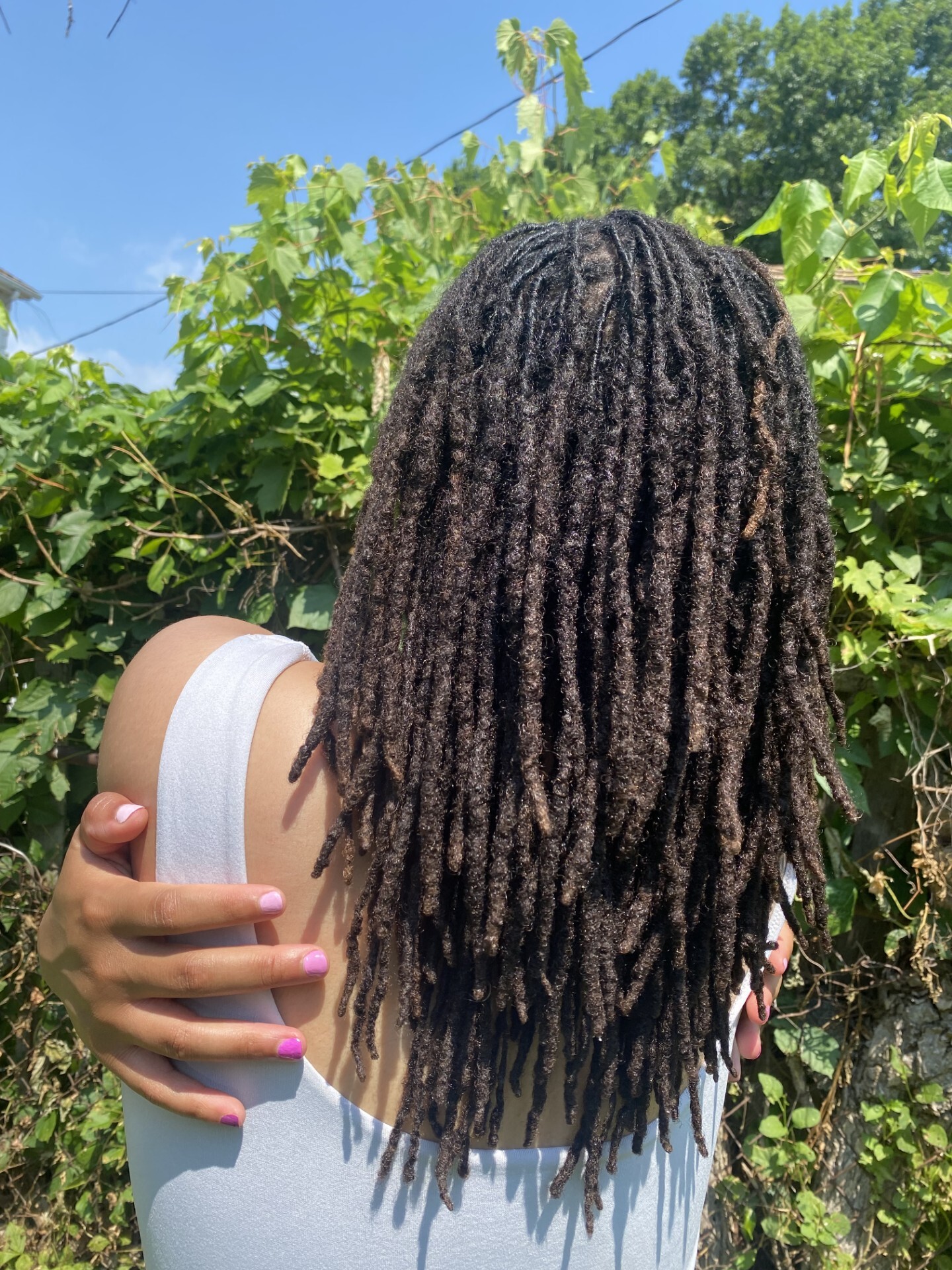
Winter is creeping up on us, which means dry, brittle hair for many awaits. This one is for all of my loc’d ladies and gents– how many of you are out there using cream conditioners as if you’re still a loose natural? It’s okay, you can come to the front, this is a safe space. I’ll admit, before I began my first-ever set of locs in 2021 while growing out a buzz cut, I approached the unknown with my usual modus operandi: I was very inspired & eager, yet equally inquisitive & cautious, so I went down my standard 200-tab rabbit hole of research on the hairstyle. I also had no close friends or family who were loc’d to see it up close & personal or give me any real advice should I have needed it. I don’t experiment frivolously with my hair; an appearance change so new and fresh in my world should be treated like DEFCON 1, and I will leave little to no room for error on my part.
Having gone through all of that research, contemplation, and sleeping on different scenarios and facts myself, I now ponder why so many loc’d people still don’t know not to 1. Wear tight styles for long periods of time, 2. Brush their locs, and 3. USE CREAM CONDITIONERS! My assumption is that because locs are touted as such a low-maintenance style, people allow any questionable behavior to go. Walk with me, let’s talk.
Recently, a loc’d friend posed the classic question to me:
“What kind of shampoo and conditioner do you use?”
Here was my answer:
“Because I have locs I don’t use conditioner. As for shampoo, I keep it very simple and use an african black soap bar for the first two washes and then a castile soap for the third and last wash. I use water to moisturize and then an oil to seal it in (sometimes).”
My friend: “I have locs too and condition regularly. May I ask why you do not condition?”
I responded: “I’ve never used cream conditioners on my locs for a few reasons: It’s used to detangle and make the hair softer for loose naturals, which would be the opposite of what I’d want for the integrity of my locs. Also, for the same reason I never use gel, conditioner can build up residue and allow dirt and lint to tack on very easily, and sometimes it’s very difficult to wash it out completely, because you cannot run your fingers through the loc itself. Lastly, most are made with harsh preservatives and agents that also affect the integrity and health of the hair, sometimes these things are also not so easily able to be rinsed out either!”
I believe that you’re a true student of life if you’ve at least taken advantage of opportunities to learn from other people’s mistakes before you have the chance to make them yourself. If you place a query in your search engine about the outcomes of using cream conditioner with locs, results come back with anecdotal (yet evident & applicable) Reddit rants and science-backed blog posts written by cosmetologists on why it has never truly been a good idea. You also have the demographic who swear it never clogs up their hair or has not diminished the texture or strength of the locs. Conditioners almost always contain silicone, preservatives, detergents and fragrance which cause build-up, dryness and brittle, slow hair growth, and affect hormones in the long run.
If you’re on the verge of using conditioner for your locs (or already are) and looking for trusted, viable solutions for moisture, you’re in the right place. I’ve had my locs for over four years now (August 7th to be exact), and I may have learned a thing or two in this short span of time. Those of us loc’d can replace the loose natural method of “conditioning” with herbal rinses, steaming, and hot oil treatments. These methods will keep your hair shiny, thick, soft, and moisturized without the build up, compromised integrity, and unnecessary chemicals in your scalp.
Hot Oil Treatments
Hot oil treatments– I’ll assume that readers are old enough to have been a part of “natural hair Twitter”, conducted natural hair Pinterest searches, or had subscribed to natural hair YouTubers that raved about hot oil treatments; narrowly, the same audience that came across co-washing, which may have had you thinking using conditioner on locs was still a great idea.
Hot oil treatments deserve their noteriety in opening up the cuticle of the hair and allowing moisture and other nutrients and antioxidants to penetrate your scalp without damaging or using chemically-laden products. I recommend using organic Jamaican black castor oil, shea butter, coconut oil, or almond oil. Always be sure to thoroughly wash the oils from your hair to avoid build up and to keep your scalp clean.
Herbal Rinses
I have noticed over the years that not many are familiar with the concept of herbal rinses, because like many holistic health topics, western (even if you are black) culture has not adopted traditional medicine as a primary form of health care, until a bit recently, in small doses. There’s nothing inherently wrong about that, because our country’s foundation is rooted in allopathic & conventional methods (chemically synthesized drugs & the removal of organs), so of course the majority would be brought up on that. Where the problem lies is that we usually stop learning and taking accountability to teach ourselves and others that there is a different or better way to do things.
An herbal rinse is an herb-infused rinse that nourishes hair with antioxidants, nutrients, and other vitamins to keep hair strong, healthy, free of irritation, and supports your locs’ shininess, softness and bounciness.
Here are the herbs I use for a refreshing herbal rinse to keep your scalp and tresses healthy, strong, and nourished:
You can infuse by simmering in a pot on the lowest setting for 7-12 hours, but if you want to take your time, store in a mason jar in a dark place for 2-6 weeks. You can find organic herbs and oils in our Marketplace!
Steaming
It’s quite as simple as it sounds– steaming your hair. This is another wonderful way to introduce your scalp and tresses to moisture absorption and promote softness and shine. The steaming process allows for the cuticle of the hair to be lifted, allowing moisture to easily penetrate and reach the deep layers of the hair shaft. I suggest coupling with nourishing hair masks and immediately before or after applying your herbal rinse and other oils like black castor and almond oils. Too much of a good thing can be just as harmful– be careful not to overdo it, resulting in breakage (the opposite of what we want) so no more than 15-20 minutes at a time, every 2-4 weeks at most.
Be relentless about your hair care, as you are in other areas of your life. Xoxo, Amber
Having gone through all of that research, contemplation, and sleeping on different scenarios and facts myself, I now ponder why so many loc’d people still don’t know not to 1. Wear tight styles for long periods of time, 2. Brush their locs, and 3. USE CREAM CONDITIONERS! My assumption is that because locs are touted as such a low-maintenance style, people allow any questionable behavior to go. Walk with me, let’s talk.
Recently, a loc’d friend posed the classic question to me:
“What kind of shampoo and conditioner do you use?”
Here was my answer:
“Because I have locs I don’t use conditioner. As for shampoo, I keep it very simple and use an african black soap bar for the first two washes and then a castile soap for the third and last wash. I use water to moisturize and then an oil to seal it in (sometimes).”
My friend: “I have locs too and condition regularly. May I ask why you do not condition?”
I responded: “I’ve never used cream conditioners on my locs for a few reasons: It’s used to detangle and make the hair softer for loose naturals, which would be the opposite of what I’d want for the integrity of my locs. Also, for the same reason I never use gel, conditioner can build up residue and allow dirt and lint to tack on very easily, and sometimes it’s very difficult to wash it out completely, because you cannot run your fingers through the loc itself. Lastly, most are made with harsh preservatives and agents that also affect the integrity and health of the hair, sometimes these things are also not so easily able to be rinsed out either!”
I believe that you’re a true student of life if you’ve at least taken advantage of opportunities to learn from other people’s mistakes before you have the chance to make them yourself. If you place a query in your search engine about the outcomes of using cream conditioner with locs, results come back with anecdotal (yet evident & applicable) Reddit rants and science-backed blog posts written by cosmetologists on why it has never truly been a good idea. You also have the demographic who swear it never clogs up their hair or has not diminished the texture or strength of the locs. Conditioners almost always contain silicone, preservatives, detergents and fragrance which cause build-up, dryness and brittle, slow hair growth, and affect hormones in the long run.
If you’re on the verge of using conditioner for your locs (or already are) and looking for trusted, viable solutions for moisture, you’re in the right place. I’ve had my locs for over four years now (August 7th to be exact), and I may have learned a thing or two in this short span of time. Those of us loc’d can replace the loose natural method of “conditioning” with herbal rinses, steaming, and hot oil treatments. These methods will keep your hair shiny, thick, soft, and moisturized without the build up, compromised integrity, and unnecessary chemicals in your scalp.
Hot Oil Treatments
Hot oil treatments– I’ll assume that readers are old enough to have been a part of “natural hair Twitter”, conducted natural hair Pinterest searches, or had subscribed to natural hair YouTubers that raved about hot oil treatments; narrowly, the same audience that came across co-washing, which may have had you thinking using conditioner on locs was still a great idea.
Hot oil treatments deserve their noteriety in opening up the cuticle of the hair and allowing moisture and other nutrients and antioxidants to penetrate your scalp without damaging or using chemically-laden products. I recommend using organic Jamaican black castor oil, shea butter, coconut oil, or almond oil. Always be sure to thoroughly wash the oils from your hair to avoid build up and to keep your scalp clean.
Herbal Rinses
I have noticed over the years that not many are familiar with the concept of herbal rinses, because like many holistic health topics, western (even if you are black) culture has not adopted traditional medicine as a primary form of health care, until a bit recently, in small doses. There’s nothing inherently wrong about that, because our country’s foundation is rooted in allopathic & conventional methods (chemically synthesized drugs & the removal of organs), so of course the majority would be brought up on that. Where the problem lies is that we usually stop learning and taking accountability to teach ourselves and others that there is a different or better way to do things.
An herbal rinse is an herb-infused rinse that nourishes hair with antioxidants, nutrients, and other vitamins to keep hair strong, healthy, free of irritation, and supports your locs’ shininess, softness and bounciness.
Here are the herbs I use for a refreshing herbal rinse to keep your scalp and tresses healthy, strong, and nourished:
- Vinegar (16oz)
- Lavender
- Calendula
- Eucalyptus
- Rosemary
- Chamomile
- Neem
- Peppermint
You can infuse by simmering in a pot on the lowest setting for 7-12 hours, but if you want to take your time, store in a mason jar in a dark place for 2-6 weeks. You can find organic herbs and oils in our Marketplace!
Steaming
It’s quite as simple as it sounds– steaming your hair. This is another wonderful way to introduce your scalp and tresses to moisture absorption and promote softness and shine. The steaming process allows for the cuticle of the hair to be lifted, allowing moisture to easily penetrate and reach the deep layers of the hair shaft. I suggest coupling with nourishing hair masks and immediately before or after applying your herbal rinse and other oils like black castor and almond oils. Too much of a good thing can be just as harmful– be careful not to overdo it, resulting in breakage (the opposite of what we want) so no more than 15-20 minutes at a time, every 2-4 weeks at most.
Be relentless about your hair care, as you are in other areas of your life. Xoxo, Amber